HMS Powerful
From Warlike
Q2121074
HMS Powerful was the lead ship of her class of two protected cruisers built for the Royal Navy (RN) in the 1890s. She was initially assigned to the China Station and then provided landing parties which fought in the Siege of Ladysmith of 1899–1900 during the Second Boer War. After a lengthy refit, the ship was placed in reserve until 1905 when Powerful became the flagship of the Australia Station. Upon her return home in 1912, she was again reduced to reserve for a brief time before she was reclassified as a training ship. The ship remained in this role until 1929 when she was sold for scrap.
1897
Wikimedia, Wikidata
speed 22 knot,
Vickers Limited, Royal Navy, United Kingdom of Great Britain and Ireland, 
Location: KML, Cluster Map, Maps,
 H.M.S. Powerful
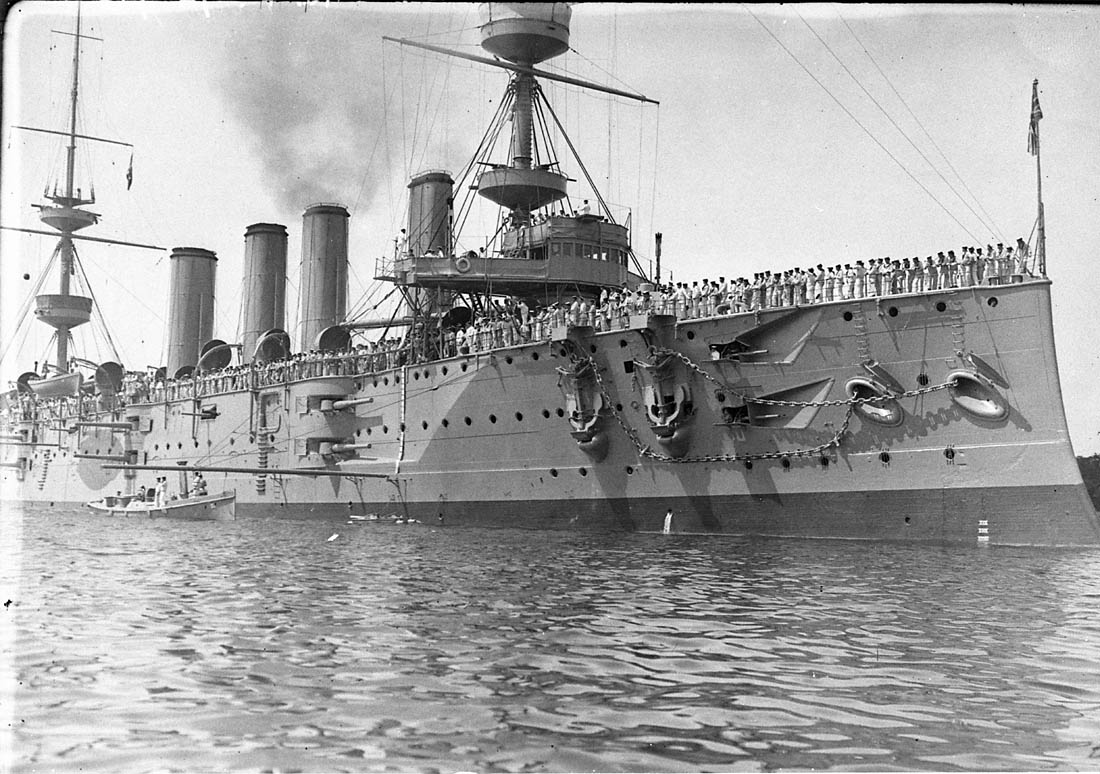 HMSPowerfulCirca1905
 HMS Powerful Starboard 6 inch guns
 More Naval Guns for the Front, the crowd cheering Bluejackets in Durban
 William Mackenzie Thomson - HMS Powerful 1st Class Cruiser launched 1895 PW7805
 Launch of H.M. Cruiser 'Powerful' - Taking the Water - 1896
 HMS Powerful, returning from South Africa, steaming up the English Channel, by Charles Edward DixonH.M.S. Powerful
 Sydney Ferry CARABELLA (later KARABELLA) at HMS POWERFUL 1905 to 1911HMS Powerful, returning from South Africa, steaming up the English Channel, by Charles Edward Dixon
| Type | Subtype | Date | Description | Notes | Source |
|---|---|---|---|---|---|
| link | page | Dreadnought Project page@ | Wikidata | ||
| commons | image | H.M.S. Powerful | Commons | ||
| commons | image | HMSPowerfulCirca1905 | Commons | ||
| commons | image | HMS Powerful Starboard 6 inch guns | Commons | ||
| commons | image | More Naval Guns for the Front, the crowd cheering Bluejackets in Durban | Commons | ||
| commons | image | William Mackenzie Thomson - HMS Powerful 1st Class Cruiser launched 1895 PW7805 | Commons | ||
| commons | image | Launch of H.M. Cruiser 'Powerful' - Taking the Water - 1896 | Commons | ||
| commons | image | HMS Powerful, returning from South Africa, steaming up the English Channel, by Charles Edward Dixon | Commons | ||
| commons | image | H.M.S. Powerful | Commons | ||
| commons | image | Sydney Ferry CARABELLA (later KARABELLA) at HMS POWERFUL 1905 to 1911 | Commons | ||
| commons | image | HMS Powerful, returning from South Africa, steaming up the English Channel, by Charles Edward Dixon | Commons | ||


_at_HMS_POWERFUL_1905_to_1911.jpg)