Black Hills Expedition
From Warlike
Q662506
The Black Hills Expedition was a United States Army expedition in 1874 led by Lieutenant Colonel George Armstrong Custer that set out on July 2, 1874, from Fort Abraham Lincoln, Dakota Territory, which is south of modern day Mandan, North Dakota, with orders to travel to the previously uncharted Black Hills of South Dakota. Its mission was to look for suitable locations for a fort, find a route to the southwest, and to investigate the possibility of gold mining. Custer and his unit, the 7th Cavalry, arrived in the Black Hills on July 22, 1874, with orders to return by August 30. The expedition set up a camp at the site of the future town of Custer; while Custer and the military units searched for a suitable location for a fort, civilians searched for gold, and it is disputed whether or not any substantial amount was found. Nonetheless, this prompted a mass gold rush which in turn antagonised the Sioux Indians who had been promised protection of their sacred land through Treaties made by the US government, and who were later to kill Custer at the Battle of the Little Big Horn in the Great Sioux War of 1876–1877 between themselves and the United States.

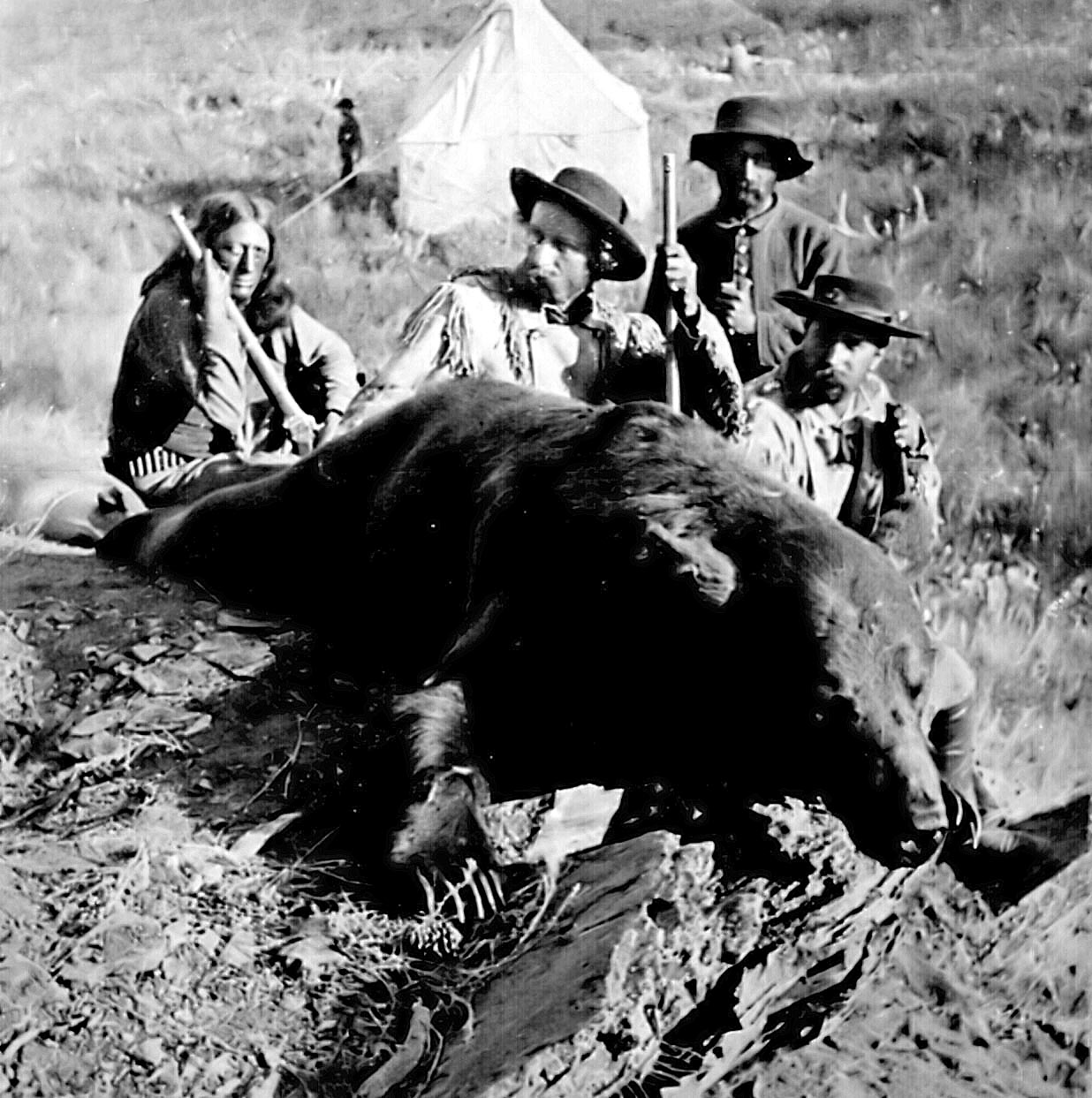 Custers Bear
 Column of cavalry, artillery, and wagons, commanded by Gen. George A. Custer, crossing the plains of Dakota Territory. B - NARA - 519427
 A panoramic view of the camp at Hidden Wood Creek. By Illingworth, 1874, during Custer's Black Hills expedition - NARA - 519425
 "Our First Grizzly, killed by Gen. Custer and Col. Ludlow." By Illingworth, 1874, during Black Hills expedition - NARA - 519426
 Custerblackhills
 CUSTER74expedition
 Custer1
 A group of 7th Cavalry officers, including Colonel Fred D. Grant on the 1874 Custer Expedition to the Black Hills - DPLA - 8ac72048e63d34c1b590ae816a9e656a
 George Armstrong Custer, 1839-1876, posed with a Bear he killed in the Black Hills, South Dakota, 1874 (cropped)
 George Armstrong Custer, 1839-1876, posed with bear he killed in the Black Hills, South Dakota, 1874 LCCN2005689322


.jpg)
