Republic XF-12 Rainbow
From Warlike
Q2145321
The Republic XF-12 Rainbow was an American four-engine, all-metal prototype reconnaissance aircraft designed by the Republic Aviation Company in the late 1940s. Like most large aircraft of the era, it used radial engines, specifically the Pratt & Whitney R-4360 Wasp Major. The XF-12 was referred to as "flying on all fours" meaning: four engines, 400 mph (640 km/h) cruise, 4,000 mi (6,400 km) range, at 40,000 ft (12,000 m). The aircraft was designed to maximize aerodynamic efficiency. Although innovative, the jet engine and the end of World War 2 made it obsolete, and it did not enter production. A proposed airliner variant, the RC-2, was deemed uneconomical and cancelled before being built.
Wikimedia, Wikidata
Republic Aviation Corporation, United States, 
Aero Ae 03, Aero Ae 50, OV-1E Mohawk,
-
Location: KML, Cluster Map, Maps,
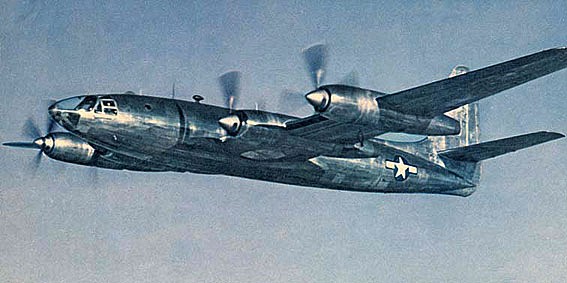 XF12
XF12 Republic XF-12 Rainbow
 Republic XR-12 Rainbow - Eglin AFB Florida
 Republic RC-2 Rainbow (5168099731)
 Republic Rainbow (5168697920)
 Republic XF-12 Rainbow In photo is the Republic XF-12 Rainbow, P-47 Thunderbolt and RC-3 Seabee. In October 1943, Republic was tasked with creating a truly strategic reconnaissance aircraft that (16335599962)
 Republic XF-12 Rainbow, Republic was tasked with creating a truly strategic reconnaissance aircraft that turned out to be a very beautiful-looking aircraft that well deserved the name Rainbow. That (16150670877)
 Rainbow xf12
 Desktop models of the Vought V-173 and F5U STOL aircraft, Ryan FR-1 Fireball mixed-power fighter, Grumman F8F Bearcat fighter, and Republic XF-12 Rainbow photo-reconnaissance aircraft
 XF-12, F8F, FR, V-173, and F5U desktop models

.jpg)
.jpg)
.jpg)
.jpg)


