V-2 rocket
From Warlike
Q174640
The V-2 rocket, with the development name Aggregat-4 (A4), was the world's first long-range guided ballistic missile. The missile, powered by a liquid-propellant rocket engine, was developed during the Second World War in Nazi Germany as a "vengeance weapon" and assigned to attack Allied cities as retaliation for the Allied bombings of German cities. The V2 rocket also became the first artificial object to travel into space by crossing the Kármán line with the vertical launch of MW 18014 on 20 June 1944.
1946 — 1952
Wikimedia, Wikidata
A4; Aggregat-4; V-2
length 14 metre, mass 12500 kilogram,
Mittelwerk, Aggregate, United States, Soviet Union, Nazi Germany, United Kingdom, Canada,
File:Fusée V2.jpg
Aggregate, V-2 sounding rocket, V-weapons,

- Blue Paw Print page@
Location: KML, Cluster Map, Maps,
-

V-2 sounding rocket ⓘ
rocket based on German V-2 carrying scientific instruments
 WWII images of the V-2 flying bomb
 V2 napęd MLP 09
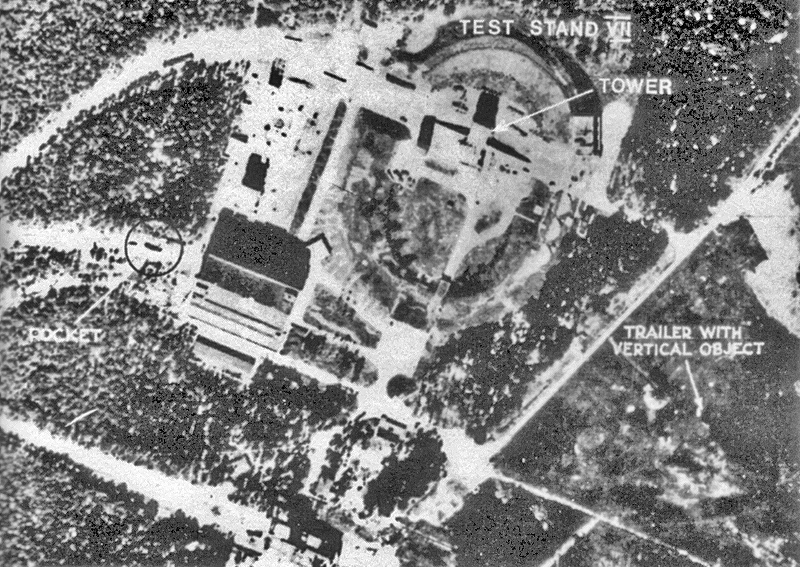 Peenemunde test stand VII
| Type | Subtype | Date | Description | Notes | Source |
|---|---|---|---|---|---|
| class | weapon | V-2 sounding rocket | sounding rocket, V-2 rocket | Wikidata | |
| link | page | Blue Paw Print page@ | Wikidata | ||
| commons | image | The British Army in North-west Europe 1944-45 B11556 | Commons | ||
| commons | image | V-2 missile at the MSFC rocket park | Commons | ||
| commons | image | WWII images of the V-2 flying bomb | Commons | ||
| commons | image | Peenemünde 2023 1 | Commons | ||
| commons | image | V-2 missile on train at Bromskirchen, Germany, 3 April 1945 (111-SC-203380) | Commons | ||
| commons | image | V2 napęd MLP 08 | Commons | ||
| commons | image | Air-34-184s2a | Commons | ||
| commons | image | V2 napęd MLP 09 | Commons | ||
| commons | image | Peenemunde test stand VII | Commons | ||
| commons | image | Air-34-632s2b | Commons | ||


.jpg&action=edit&redlink=1)


